





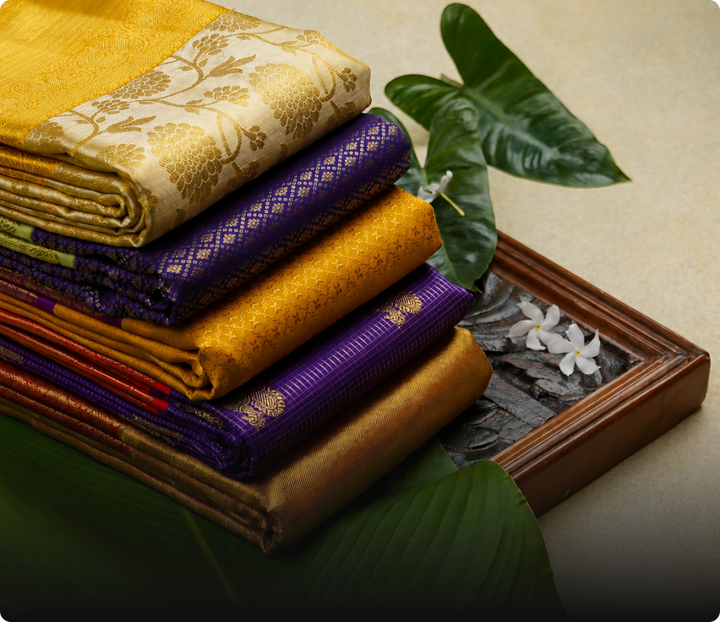


Admiral blue retta pettu pure silk saree
py7430
- Free Shipping Across India | 4-5 Days

- Color : Blue
- Blouse Color : Blue
- Zari : Gold
- Weaving Technique : Traditional weave
This is a saree of rare architectural confidence — a deep royal blue pure mulberry Kanjivaram where the entire design vocabulary is expressed through structural weave and zari technique rather than colour contrast. The royal blue ground is intense, saturated, and deeply lustrous — a colour that has historically been associated with authority, devotion, and ceremonial importance across South Indian textile traditions. In direct light, the silk shifts between cobalt and indigo, giving the saree a living, dynamic quality that changes with the angle of view and the quality of light.
The body is kept deliberately clean and open — a wide, uncluttered expanse of royal blue silk that allows the full luminosity of the pure mulberry thread to assert itself. Scattered across this ground at measured intervals are precisely woven star-shaped gold zari buttas — small, sharply defined eight-pointed star motifs that punctuate the body with quiet brilliance. These buttas are woven using the extra weft technique, sitting proud of the silk ground and catching light independently, creating a celestial, jewel-scattered effect across the body.
The border is the defining structural statement of this saree — a double-layered construction executed in the prestigious retta pettu and pattu pettu tradition. Retta pettu, meaning "double fold" or "double layer" in Tamil, refers to a border that is woven with two distinct layers of structure — the silk ground and the zari pattern — interlocked in a way that gives the border exceptional body, stiffness, and visual depth. The pattu pettu layer adds a further silk-dominant band within the border composition, creating a multi-register border of considerable width and complexity. Together, the retta pettu and pattu pettu construction results in a border of extraordinary weight and architectural presence — one that frames the blue body with the kind of authority that only multi-layer Kanjivaram weaving can achieve. The border surface carries a repeating geometric-floral pattern in antique gold zari against the blue ground, with layered zari bands of varying widths creating a structured, graduated border composition from inner edge to outer edge.
The pallu is woven in the adukku pettu seer style — a stacked, tiered pallu construction where the design is organised into horizontal registers of repeating geometric and temple motifs, stacked one above the other in a structured sequence. Adukku means "stack" or "tier" in Tamil, and seer refers to the orderly, measured arrangement of these tiers — the result is a pallu with the visual effect of a woven architectural elevation, each register of motifs sitting precisely above the next in a disciplined, rhythmic composition. The entire pallu is executed in the same royal blue and antique gold zari as the body and border, maintaining complete monotone integrity. The blouse piece is woven in matching royal blue silk with tonal zari detailing, completing the unified, self-colour ensemble.
MOTIF GUIDE
01 — Ashtakona Star Butta (Eight-Pointed Star) The primary body motif — a precisely woven eight-pointed star in antique gold zari, placed at regular intervals across the royal blue ground. The ashtakona or eight-pointed star is one of the oldest geometric symbols in Indian temple art and textile traditions, representing the eight directions (ashtadikpalakas) and the completeness of the cosmos. In Kanjivaram weaving, the star butta is a classic body motif that has been woven for centuries — its sharp, geometric form lends itself perfectly to the structured warp-and-weft grid of the silk loom. Each star is woven as an extra weft float, sitting fractionally above the silk surface and catching light with a precision that scattered floral buttas cannot match.
02 — Retta Pettu Border Construction Not an ornamental motif but the foundational structural technique of this saree's border. Retta pettu — "double fold" — refers to a border woven with two interlocked structural layers, giving it a thickness, stiffness, and visual density that single-layer borders cannot achieve. The retta pettu border has a characteristic weightiness when held — it falls with authority and holds its shape through a drape. This construction is one of the most demanding in Kanjivaram weaving and is considered a mark of premium craftsmanship and material investment.
03 — Pattu Pettu Border Band The pattu pettu layer within the border — a silk-dominant band woven as part of the multi-register border composition. In the pattu pettu register, the silk thread dominates over the zari, creating a section of the border where the royal blue ground asserts itself within the zari-heavy border field. This creates a visual rhythm within the border — alternating between zari-dominant and silk-dominant registers — that gives the border its characteristic layered, multi-panel appearance visible in this saree.
04 — Geometric Temple Border Motif (Kovil Petti) Within the border field, a repeating geometric motif derived from temple architecture — stepped, angular forms that echo the plan geometry of South Indian temple sanctuaries and their surrounding prakarams. These motifs are woven in gold zari in a structured repeat across the full length of the border, forming the primary decorative element within the retta pettu construction.
05 — Layered Zari Band Registers (Patta Rekha) Multiple parallel bands of varying-width gold zari running along the length of the border — the structured framework that organises the border's visual hierarchy. The patta rekha system divides the border into registers: a narrow inner line (katari rekha), one or more mid-width decorative bands, and a broader outer band. Together these create the graduated, architectural border composition visible in this saree.
06 — Adukku Pettu Seer Pallu The defining weave structure of the pallu — a tiered, stacked pallu construction where geometric and temple-inspired motifs are organised into precise horizontal registers, one stacked above the other across the full width of the pallu. Each register carries a distinct geometric motif or pattern in gold zari, and the registers are separated by fine zari lines that mark the tier boundaries cleanly. The adukku pettu seer pallu has a strong visual resemblance to the horizontal banding of a woven temple tower — structured, repetitive, and deeply rooted in South Indian sacred geometry. This pallu style is associated with classical Kanjivaram weaving from the pre-Independence period and represents one of the most traditional pallu treatments in the canon.
07 — Temple Gopuram Tier Motif (Pallu Register) Within each tier of the adukku pettu pallu, individual motifs derived from gopuram and temple architecture are woven in gold zari — stepped pyramidal forms, arched niches, and geometric units that collectively read as a woven architectural elevation. These motifs are among the oldest in the Kanjivaram vocabulary, drawing directly from the visual language of the great Pallava and Chola temple complexes of Tamil Nadu.
08 — Pallu Hem Border (Mariyaadai) The pallu is completed with a bold, structured zari hem border of considerable width — a high-density gold zari weave that anchors the trailing edge of the pallu with decorative authority and formal finish. The hem border carries a distinct repeating geometric-floral pattern that closes the pallu composition with a strong, definitive visual line.
OCCASION GUIDE & JEWELLERY PAIRINGS
Wedding — Bride Royal blue is one of the most powerful and photogenic bridal Kanjivaram colours — deeply auspicious in South Indian tradition and visually commanding under both natural and stage lighting. The monotone construction with retta pettu border and adukku pettu pallu signals heirloom-grade craftsmanship to those who know, making this an exceptional choice for a bride who values connoisseurship over obvious ornamentation. Jewellery: Full antique gold temple jewellery set · Lakshmi haar or long gold necklace with rubies · Heavy gold jhumkas or chandelier earrings · Gold vanki (armlet) · Maang tikka · Oddiyanam (gold waist belt) · Gold netti chutti for a classical bridal look
Wedding — Bride's Mother / Senior Family The commanding depth of royal blue and the structural gravity of the retta pettu border make this saree an ideal choice for the mother of the bride or groom — authoritative, celebratory, and unmistakably Kanjivaram. The monotone palette reads as refined and considered rather than loud. Jewellery: Antique gold necklace set with ruby or emerald drops · Gold jhumkas · Gold bangles stacked · Broad gold chain
Wedding — Muhurtham Function (Auspicious Core Ceremony) The deep royal blue is a traditionally auspicious colour for the muhurtham ceremony in many Tamil and Telugu communities. The heavy retta pettu border ensures the saree holds its drape with authority through the ceremony, while the star buttas carry the symbolism of the eight directions — auspicious for a new beginning. Jewellery: Temple gold necklace · Gold jhumkas · Full gold bangle set · Gold maang tikka
Navarathri Golu Blue occupies an important place in the Navarathri colour calendar, and a royal blue Kanjivaram of this structural complexity is a celebrated choice for the festival. The star buttas carry a particular resonance during Navarathri, associated with the celestial and the divine feminine. Jewellery: Kemp and gold necklace in blue or green stones · Temple earrings · Silk pottu and matching bangles · Gold chain with pendant
Griha Pravesam The combination of auspicious colour, star motifs, and temple-derived pallu architecture makes this saree deeply appropriate for a housewarming ceremony — the star buttas symbolise light and direction, while the temple gopuram pallu carries a blessing-like symbolic resonance for a new home. Jewellery: Antique gold necklace · Gold jhumkas · Thin gold bangles · Simple gold chain
Government / Official Ceremonial Functions The deep royal blue monotone Kanjivaram with its structured border and disciplined pallu is one of the most appropriate sarees for formal government functions, official receptions, award ceremonies, and state-level cultural events. The saree communicates cultural authority and sartorial seriousness without ostentation. Jewellery: Single gold necklace with pendant · Gold stud or small drop earrings · Minimal gold bangles · Fine gold chain
Anniversary & Milestone Celebrations For 25th or 50th wedding anniversaries, milestone family celebrations, or senior felicitation events, this saree carries exactly the right combination of cultural weight, personal elegance, and material richness. The retta pettu border ensures it reads as a saree of significance to any knowledgeable audience. Jewellery: Diamond and gold combination necklace · Pearl or diamond drop earrings · Gold or diamond bangles
HERITAGE
The retta pettu border is one of the most unambiguous markers of classical Kanjivaram weaving — a construction technique that requires the border to be woven simultaneously with the body on an entirely separate set of warp threads, interlocked at the selvage, and built up in two structural layers that give it a body and stiffness no other technique can replicate. In the weaving families of Kanchipuram, the retta pettu saree has historically been the benchmark of a master weaver's skill — the piece by which a weaver's reputation was established and passed down. The adukku pettu seer pallu that accompanies the border in this saree belongs to an even older tradition — a pallu architecture drawn directly from the horizontal register compositions of Pallava and Chola temple sculpture, where stories and deities were arranged in tiered, stacked rows across stone surfaces. The Kanjivaram weaver did not merely copy this architecture — he translated it into thread, encoding the grammar of sacred space into a length of silk that a woman could carry on her body. To wear this saree is to wear that grammar — the star, the temple tier, the double border — each element a word in a visual language that has been spoken in silk for over a thousand years.
Free Shipping with across India.
For international shipping Over Rs.35,000/- free.
Estimated to be delivered - set it as 3-5 days from ordering
For urgent delivery
Reach out to our watsapp -7550088643
The colour rendition of the products may vary according to the ambient lighting conditions and the colour calibration of digital LED devices. If you would like more clarity before your purchase, please contact our experts at Watsapp 7550088643 or support@priyangaa.in

