





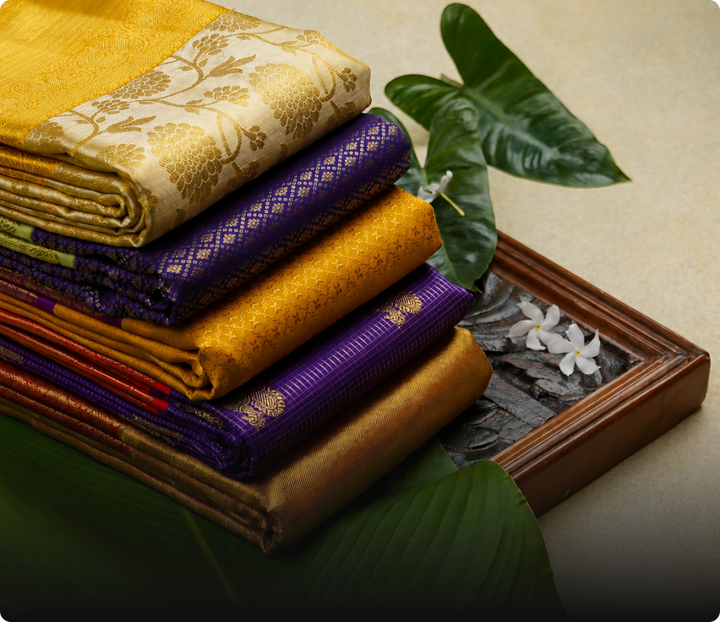


Elachi green and purple retta pettu pure silk saree
py7440
- Free Shipping Across India | 4-5 Days

- Color : Elachi green
- Blouse Color : Purple
- Zari : Gold
- Weaving Technique : Traditional weave
This is a saree of exceptional classical pedigree — a colour combination that sits squarely within the most celebrated and historically significant pairings in the Kanjivaram canon. Elachi green — named after the cardamom pod, a warm, luminous gold-green with a faint yellow undertone — is one of the most coveted ground colours in pure Kanjivaram silk. It is a colour that reads differently in every light: in natural daylight it glows with a warm, almost metallic luminosity; in indoor light it deepens into a rich, honeyed gold-green that is unlike any other colour in the textile world. Paired against a deep, saturated violet-purple border, this saree delivers one of the most visually arresting and traditionally rooted contrasts in South Indian weaving — a combination that has been chosen by Kanjivaram connoisseurs, temple donors, and royal families for generations.
The body is a wide, uninterrupted expanse of pure elachi green mulberry silk — clean, open, and allowed to speak entirely through its own luminosity. The silk surface carries a subtle self-woven texture, the natural result of the tight, high-tension warp and weft construction of pure Kanjivaram, which gives the body a characteristic crispness and body that drapes with authority. The absence of body buttas or all-over weave on the ground is a deliberate design choice — the elachi green silk is so inherently beautiful that any additional motif would compete with rather than complement it. The body is the statement; everything else is architecture.
The border is constructed in the prestigious retta pettu tradition — a double-layered border woven simultaneously with the body on separate warp threads and interlocked at the selvage, giving it the characteristic thickness, weight, and stiffness that distinguishes a true retta pettu Kanjivaram from all lesser constructions. The border ground is the deep violet-purple, into which thandavalam motifs and floral elements are woven in antique gold zari in a rich, dense repeat. The thandavalam — a rhythmic, wave-like or procession-inspired border motif — runs as a continuous horizontal pattern through the border field, punctuated by individual floral units that add a naturalistic softness to the geometric forward movement of the thandavalam design. Multiple layered zari bands frame the border on both inner and outer edges, creating a multi-register border composition of considerable visual complexity and weight.
The pallu is woven as a full brocade — the most material-intensive and technically demanding pallu treatment in Kanjivaram weaving. The deep purple ground is covered edge to edge with a dense, interlocking brocade composition in antique gold zari — a rich, all-over field of thandavalam-inspired wave motifs, floral units, and geometric fills that leaves almost no ground silk visible. The brocade pallu has a distinctive heaviness and three-dimensionality; the gold zari floats above the silk surface in a high-relief construction that creates texture, shadow, and light-play simultaneously. Layered zari border bands frame the pallu on all edges, with a bold decorative hem border completing the pallu's edge with ceremonial finality. The blouse piece is woven in matching deep purple silk with gold zari detailing on the sleeve and border, ensuring complete visual unity between pallu and blouse in the draped saree.
MOTIF GUIDE
01 — Thandavalam (Procession Wave Motif) The primary and defining motif of this saree's border and pallu — a continuous, rhythmic wave or procession pattern that moves horizontally across the weave. The word thandavalam in Tamil refers to a ceremonial procession or parade, and the motif captures exactly that sense of forward movement — a flowing, undulating line that carries within it smaller floral or geometric units, like figures in a procession. In Kanjivaram tradition, the thandavalam motif is associated with temple procession culture, where deities are carried through the streets in decorated chariots — the motif is a textile translation of that movement and grandeur. Woven in antique gold zari on the deep purple ground, the thandavalam creates a border composition of exceptional visual rhythm and cultural depth.
02 — Poo Motif (Floral Unit) Individual floral motifs woven in gold zari within and alongside the thandavalam wave in the border field. These floral units — stylised blooms rendered in the structured, geometric manner characteristic of Kanjivaram extra-weft weaving — punctuate the continuous movement of the thandavalam with moments of stillness and fullness. Each floral unit is a compact, symmetrical composition of petals radiating from a central gold point, woven with precision using the extra weft float technique.
03 — Retta Pettu Border Construction The structural foundation of the border — a double-layered border construction where two independent sets of warp threads are maintained simultaneously through the weaving process and interlocked at the selvage. The retta pettu method produces a border of exceptional body, stiffness, and visual density — the border in this saree will hold its shape through a full day of wearing, fall in a clean, straight line at the hem, and carry the heavy gold zari brocade without puckering or distorting. This construction is the most demanding border technique in the Kanjivaram repertoire and is the primary marker of a premium-grade handloom saree.
04 — Layered Zari Band Registers (Patta Rekha) Multiple parallel bands of varying-width gold zari running along the full length of the border — a structured, hierarchical framework that divides the border into inner line, decorative field, and outer edge registers. In this saree, the patta rekha system creates a strong, multi-layered border architecture that frames the thandavalam and floral field on both sides with clean, authoritative zari lines.
05 — Katari Rekha (Inner Zari Dividing Line) A fine, sharp gold zari line at the inner edge of the border — the precise boundary between the elachi green body and the purple border. In a high-contrast korvai saree of this calibre, the katari rekha performs both a structural and an aesthetic function: it marks the selvage join cleanly and creates a visual breath between the two colour fields before the eye moves into the full complexity of the border.
06 — Full Brocade Pallu Jaal The pallu's all-over brocade composition — a dense, interlocking field of thandavalam wave forms, floral units, and geometric filler elements woven in antique gold zari across the entire purple pallu ground. In a full brocade pallu, the zari coverage is so dense that the silk ground is almost entirely obscured — the pallu surface reads as a gold textile with purple undertones rather than a purple textile with gold pattern. This level of zari density requires an extraordinary investment of both material and weaving time and is the mark of a saree positioned at the top of the Kanjivaram quality hierarchy.
07 — Brocade Pallu Border Panels The pallu is additionally structured with vertical and horizontal border panels in gold zari that divide the pallu field into geometric registers — a characteristic of the rich brocade pallu style that gives the pallu a quilt-like, panelled appearance when laid flat. These panels create a further layer of pattern architecture within the already dense brocade field, adding depth and visual complexity to the pallu's surface.
08 — Pallu Hem Border (Mariyaadai) A bold, wide decorative hem border in gold zari closes the pallu's trailing edge — a high-density weave carrying a distinct geometric-floral repeat that provides a strong visual terminus to the brocade pallu composition. The mariyaadai in this saree is of considerable width, appropriate to the ceremonial weight of the full brocade pallu it closes.
OCCASION GUIDE & JEWELLERY PAIRINGS
Wedding — Bride (Muhurtham / Core Ceremony) The elachi green and purple combination is among the most auspicious and traditionally celebrated bridal colour pairings in Tamil and Telugu wedding culture — deeply rooted in Kanjivaram heritage and instantly recognisable as a saree of the highest intent. The full brocade pallu carries the weight and grandeur expected of a muhurtham saree, while the luminous elachi green body photographs with extraordinary beauty under all lighting conditions — golden, natural, and stage light alike. Jewellery: Full antique gold temple bridal set · Lakshmi haar with rubies or emeralds · Heavy gold jhumkas or chandelier earrings · Gold vanki (armlet) · Oddiyanam (waist belt) · Maang tikka · Netti chutti for full classical bridal look
Wedding — Bride's Mother (Manaivi / Ponnu Veedu) In Tamil wedding tradition, the bride's mother often wears a saree of comparable ceremonial weight to the bride — and an elachi green retta pettu Kanjivaram with brocade pallu positions her as a woman of taste and heritage authority. The colour combination signals that this family knows its silk. Jewellery: Antique gold necklace set with ruby drops · Heavy gold jhumkas · Full gold bangle set · Broad gold chain · Simple gold maang tikka
Wedding — Senior Gifting Saree (Sambandhi Gift) The elachi green and purple Kanjivaram with full brocade pallu is a classic senior gifting saree — presented by one family to another's matriarch as a mark of respect, alliance, and generosity. The retta pettu construction and brocade pallu communicate the seriousness of the gift to anyone who receives it with knowledge. Jewellery (recipient): Antique gold necklace · Gold jhumkas · Gold bangles · Pearl or gold chain
Temple Visits & Deity Offering (Kovil Saree) Elachi green is considered deeply auspicious and is one of the colours most frequently chosen for sarees offered to temple deities or worn for significant temple visits, consecration ceremonies, and annual family deity festivals. The thandavalam motif — with its direct reference to temple procession culture — makes this saree particularly resonant in a devotional context. Jewellery: Antique gold necklace · Gold jhumkas · Gold bangles · Kumkum and vibhuti as appropriate
Navarathri Golu — Featured Day On the specific Navarathri day associated with green or gold in the colour-day calendar, an elachi green Kanjivaram of this stature is the definitive choice. The purple border ensures strong visual presence at any gathering, while the brocade pallu creates a memorable impression during stage or step presentations. Jewellery: Kemp and gold necklace with green stones · Temple earrings · Silk pottu and glass bangles in green and gold · Long gold chain
Seemantham / Valaikaapu Ceremony Both elachi green and purple hold auspicious significance in South Indian ceremony — green for fertility and new life, purple for protection and divine favour. The combination in a ceremonial-weight saree makes this a meaningful and visually striking choice for the mother-to-be or her close family at a seemantham. Jewellery: Pearl and gold necklace · Gold jhumkas · Glass bangles in green and gold · Floral jewellery alongside gold
Griha Pravesam The auspicious green ground, temple-procession motifs, and ceremonial weight of the brocade pallu make this saree singularly appropriate for a housewarming ceremony — one of the most important domestic rituals in South Indian tradition. Wearing this saree to a griha pravesam communicates cultural seriousness and a deep regard for the occasion. Jewellery: Antique gold necklace · Gold drop earrings · Gold bangles · Fine gold chain
HERITAGE
The elachi green and purple pairing is not a contemporary design choice — it is one of the oldest and most deeply embedded colour combinations in the Kanjivaram tradition, with roots in the colour cosmology of the Pallava and Chola courts, where specific colour pairings were used in temple textiles to signify particular deities, ritual functions, and seasonal ceremonies. Green, derived historically from natural vegetable dyes, was associated with Goddess Meenakshi and the fertility of the Tamil land; purple, rarest and most precious of the natural dye colours, was reserved for the highest ritual and royal contexts. The thandavalam motif that animates the border of this saree carries that same temple-court lineage — born from the visual culture of the great chariot processions of Kanchipuram and Madurai, where the movement of the divine through the street was translated by weavers into a continuous, living wave of gold thread. The retta pettu construction that holds the border together is itself a technique of Pallava-era origin, passed down within weaving families of Kanchipuram through an unbroken oral and manual tradition spanning more than a thousand years. This saree does not carry that history as ornament — it is made of it, thread by thread, from selvage to pallu hem.
Free Shipping with across India.
For international shipping Over Rs.35,000/- free.
Estimated to be delivered - set it as 3-5 days from ordering
For urgent delivery
Reach out to our watsapp -7550088643
The colour rendition of the products may vary according to the ambient lighting conditions and the colour calibration of digital LED devices. If you would like more clarity before your purchase, please contact our experts at Watsapp 7550088643 or support@priyangaa.in

