









Lavender and wine kanchi silk saree


All taxes included


The hands behind your saree

Expert in Korvai
Kanchana
Weaving since 2006
Product Details
DESCRIPTION
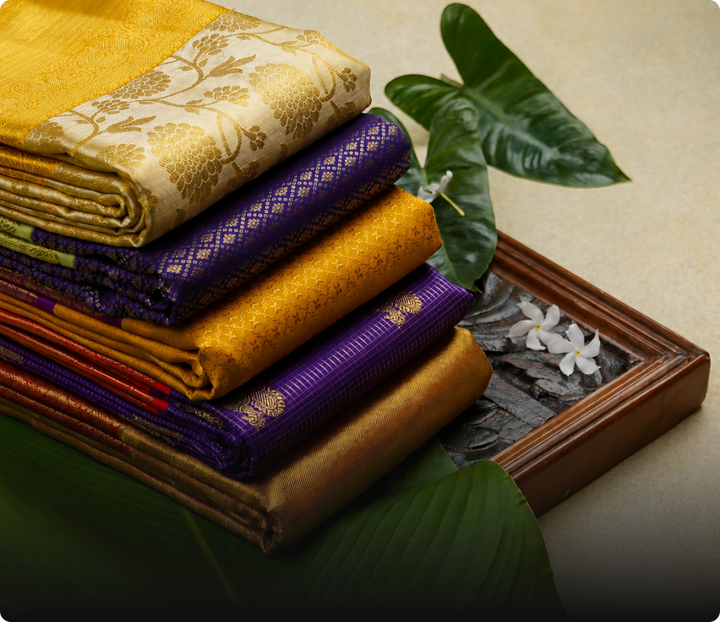
The body of this saree is woven in a soft, luminous lavender pure mulberry silk — a colour that carries an innate elegance, sitting beautifully on all skin tones and radiating a gentle, celebratory warmth. The lavender ground is kept deliberately clean and open, allowing the silk's natural lustre to shine through in its full glory. Scattered across this pristine body are finely woven gold zari floral buttas — small, precisely placed motifs that catch the light with every fold and movement, adding a quiet festive richness without overwhelming the softness of the ground.
This saree is crafted in the prestigious korvai technique — one of the most demanding and revered methods in Kanjivaram weaving. In korvai construction, the body and border are woven simultaneously on separate shuttles and then interlocked at the selvage, creating a seamless, structurally integrated join that cannot be replicated by any other method. The result is a saree where the border appears to grow organically from the body — a hallmark of true heirloom-grade Kanjivaram.
The border is a deep, commanding wine-burgundy, woven with a broad gold zari field densely packed with a repeating geometric lattice and floral vine pattern. Within this border, individual floral motifs bloom in structured gold zari, framed between fine zari lines that create a layered, architectural border composition. A contrasting gold zari inner line runs along the body edge of the border, completing the separation with precision.
The pallu is in the same deep wine, woven with an all-over gold zari jaal — a dense, interlocking lattice of geometric and floral elements that gives the pallu a jewel-like, heavily textured surface. The pallu is finished with a bold decorative zari hem, reinforcing the ceremonial grandeur of the piece. The blouse piece matches the wine-burgundy pallu, woven with a delicate gold zari pattern on the sleeve, making this a fully coordinated, ready-to-drape ensemble.
MOTIF GUIDE
01 — Poo Butta (Floral Butti) Small, individual floral motifs woven in gold zari and scattered across the lavender body at regular intervals. Each butti is a self-contained bloom, woven in with precision using the extra weft technique. They add a festive sparkle to the body without breaking the clean, open ground — a classic Kanjivaram body treatment for silk sarees of this grade.
02 — Korvai Selvage Join Not a decorative motif in the traditional sense, but the most important structural signature of this saree. The interlocked join where the lavender body silk meets the wine border silk — woven simultaneously on separate shuttles — is visible as a clean, tight, seamless line. This join is the proof of authentic korvai construction and is the mark that distinguishes a true Kanjivaram from all imitations.
03 — Zari Floral Vine Border (Poo Kodi) Running the full length of the wine border, a continuous floral creeper vine is woven in gold zari — individual blooms connected by curling stems and leaves. This is the primary decorative element of the border, rendered in structured, high-relief zari weave against the dark wine ground.
04 — Geometric Lattice Jaal (Border Field) The broad body of the border is filled with a dense geometric lattice — small diamond or square interlocking units in gold zari, creating a rich, glittering textile surface that forms the background for the floral vine. This jaal pattern is a signature of the wide-border Kanjivaram style and requires intensive multi-shuttle weaving to execute.
05 — Katari Rekha (Zari Dividing Line) A fine, sharp gold zari line runs along the inner edge of the border, creating a clean visual boundary between the lavender body and the wine border. Precise and unbroken, this line is a hallmark of skilled Kanjivaram border construction.
06 — Pallu Zari Jaal The pallu is woven with an all-over gold zari jaal — a dense, interlocking field of geometric and floral units covering the entire wine ground. This full-field zari treatment gives the pallu its characteristic weight, sheen, and ceremonial presence. The richer the jaal density, the higher the grade of the saree.
07 — Pallu Hem Border (Mariyaadai) The hem of the pallu is finished with a bold decorative zari band — a structured, high-density weave that frames the pallu's trailing edge. This finishing border, known as the mariyaadai or pallu kodi, is both decorative and functional, reinforcing the pallu end and completing the saree's composition with a strong visual anchor.
OCCASION GUIDE & JEWELLERY PAIRINGS
Wedding — Bride The lavender-wine korvai combination is a timeless bridal choice, particularly for Tamil and Telugu wedding traditions where contrast korvai Kanjivarams hold the highest ceremonial status. The clean lavender body photographs beautifully under all lighting conditions, while the heavy wine-gold pallu carries the gravitas expected of a bridal silk. Jewellery: Full antique gold bridal set with uncut diamond or kemp detailing · Lakshmi haar or long gold necklace · Heavy gold jhumkas · Gold vanki (armlet) · Maang tikka · Gold waist belt (oddiyanam)
Wedding — Bride's Mother / Close Family For the bride's mother or close female relatives, this saree strikes the perfect balance — celebratory enough to honour the occasion, refined enough not to outshine the bride. The soft lavender body is particularly flattering for daytime wedding functions. Jewellery: Antique gold necklace set with ruby or emerald drops · Gold jhumkas or chandbalis · Gold bangles · Simple gold chain
Puberty Ceremony (Manjal Neerattu Vizha) Lavender is one of the most traditionally favoured colours for a girl's coming-of-age ceremony in South Indian families. A korvai Kanjivaram in this colour combination is an auspicious and deeply meaningful gift or wearing choice for the occasion. Jewellery: Gold necklace with floral pendant · Small gold jhumkas · Gold bangles · Floral jewellery alongside gold
Seemantham / Baby Shower The soft, feminine lavender body with the rich wine border is a deeply auspicious colour pairing for seemantham ceremonies. The wine-gold pallu adds the required ceremonial weight while the lavender body keeps the look graceful and appropriate for the ritual. Jewellery: Pearl and gold necklace · Gold jhumkas · Glass bangles in lavender or gold · Gold chain
Navarathri Golu Lavender translates beautifully into the festive Navarathri colour palette — the gold zari buttas on the body and the heavy wine-gold border ensure this saree stands out in any golu gathering or stage performance context. Jewellery: Kemp and gold necklace set · Layered gold chains · Temple earrings · Silk flowers in hair alongside gold
Engagement Ceremony The contrast lavender-wine palette is an exceptional choice for engagement functions — vibrant, camera-ready, and carrying the weight of a pure Kanjivaram without feeling overly bridal. Ideal for the bride-to-be at a traditional Tamil or Telugu engagement. Jewellery: Uncut diamond or polki necklace · Gold jhumkas · Diamond or kemp bangles · Maang tikka
Anniversary & Milestone Celebrations For 25th or 50th wedding anniversaries, milestone birthdays, or retirement honours, this saree carries the right cultural gravity and visual elegance. The korvai construction alone signals heirloom quality to those who know. Jewellery: Single strand gold chain with pendant · Diamond studs or pearl drops · Thin gold bangles
HERITAGE
The korvai technique is among the most ancient and technically exacting weaving traditions in the Kanjivaram canon — a method so demanding that only a fraction of master weavers practice it in its authentic form today. Unlike ordinary sarees where the border fabric is attached or the pattern is woven in a single shuttle pass, the korvai saree is born from two simultaneous acts of weaving: the body silk and the border silk are woven at the same time on separate shuttles, interlocked at the selvage thread by thread, creating a join so seamless it appears to be a single fabric. This is not embellishment — it is architecture. Each korvai Kanjivaram is a structural feat woven on a pit loom that may take a master weaver and his family several days to complete. The lavender and wine palette in this piece echoes the colour traditions of the royal courts of Kanchipuram, where contrast korvai silks were gifted between families as symbols of alliance, prosperity, and enduring craftsmanship.


Every thread carries a name
The Weaver spent 11 days at the loom to finish what you're looking at. Every colour transition, every border detail placed by hand, with a precision that only decades of weaving can teach.
Kanchipuram's weavers have carried this craft through generations, often without recognition. At Priyangaa, we play a small role in giving the spotlight to the hands that have always been hidden.

Silk remembers every hand that touched it. I try to leave it something good
KanchanaWeaving since 2006, with expertise in Korvai.Inside the Weave
Four small details that quietly make this saree what it is.


Motifs
Look closely, and you’ll notice the little things. Inspired by nature, heritage and artistry, these motifs are thoughtfully designed to give each saree its own character.

Weaving Technique
The magic is in the way it comes together. From traditional weaves to intricate techniques, every thread is woven with intention to bring out the saree’s distinct texture, fall and form.

Zari
Sometimes it catches the light. Sometimes it quietly blends in. Every zari detail is chosen to add just the right touch of glow to your saree.

The Palette
Our colours are proudly, unmistakably our own. We create distinctive colour combinations you won’t find just anywhere, bringing together unexpected shades, timeless hues and our own unique point of view.


 Will it suit me?
Made for every skin tone
Every colour at Priyangaa is chosen with intention. Before a single thread is dyed, we consider how it will sit against every complexion, warm, cool, deep, or fair.
No one should ever feel left out of Kanjivaram silk simply because of their skin tone. That's not a thought we had once. It's a standard we hold every time we curate a new saree.
 Complete The Look
Style it your way

The classic
A timeless choice if you like your sarees to do the talking. The clean neckline and three-quarter sleeves keep your look elegant and effortless.

The Bold
Perfect when you want to make a little more of a statement. The open back and striking details bring a playful edge to your saree look.

The Minimal
For when less feels like more. The clean silhouette keeps the look understated while giving your saree all the attention.

The Romantic
A lovely choice when you want something softer and more feminine. The delicate back detail adds just the right touch without taking over the look.

The Regal
Go for this when the occasion calls for something grand. The fuller sleeves and rich detailing give your saree look a beautifully traditional, dressed-up feel.

Temple jewellery
Lakshmi haram, jhumkas, oxidised gold bangles, pairs naturally with the green base and antique zari.

Antique gold
Oxidised silver choker, silver jhumkas, a statement ring, lifts the dusky border with a modern edge.

Minimal gold
Polki choker, small diamond studs, for receptions, the green base carries the sparkle without competing.

Wedding receptions
Reception, sangeet, mehendi afternoon, the bottle green photographs beautifully in low evening light.

Festival pujas
Diwali, Pongal, Varalakshmi Vratam, the dusky border keeps it festive without feeling overly formal.

Milestone anniversaries
Engagement, anniversary dinner, baby's naming, a saree that holds the weight of the day.
Wear It Well


